
Wall Street Protests: Which Side Are You On?
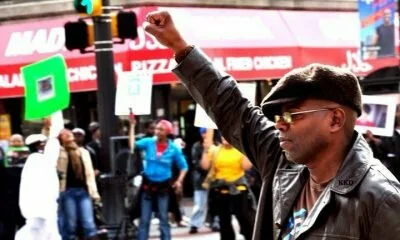
Wall Street has long been the home of the biggest threat to American Democracy. Now it has become home to what may be our best hope for rescuing it. For everyone who loves this country, for everyone whose heart is breaking for the growing ranks of the poor, for everyone who is seething at the unopposed demolition of America’s working and middle class: the time has come to get off the fence. A new generation has gone to the scene of the crimes committed against our future. The time has come for all people of good will to give our full-throated backing to the young people of the Occupy Wall Street movement. The young heroes on Wall Street today baffle the world because they have issued no demands. The villains of Wall Street had their demands — insisting upon a massive bailout for themselves in 2008, while they pocketed million dollar bonuses. The Wall Street protesters are not seeking a bailout for themselves; they are working to bail out democracy. The American experiment in self-governance is at a moment of crisis. The political system thus far has proven itself incapable of responding to a once in a lifetime economic calamity. With income inequality and unemployment at the highest rates since the Great Depression, it’s no wonder that almost 80 percent of the country thinks we’re on the wrong track. But the crisis of American Democracy did not start with the financial collapse. For at least 30 years, the system has been rigged by the wealthy and privileged to acquire more wealth and privilege. At this point, 400 families control more wealth than 180 million Americans. This great wealth divergence has resulted in an unjust and dangerous concentration of economic and political power in the hands of the few. It has pushed millions — especially the rising generation and communities of color — into the shadows of our society. The middle class continues to shrink, and the ranks of the poor have swelled. The political elite has failed to take the necessary steps to provide opportunity to the majority of Americans. A movement was born after Madison, Wisconsin, to oppose these injustices. It has now spread to every Congressional District. We call ourselves the American Dream Movement. We engaged 130,000 people to crowd-source our own jobs agenda — the Contract for the American Dream . In August, tens of thousands demonstrated for jobs in rallies across the nation. Next week in DC, we host our first national gathering: the Take Back The American Dream conference . The Occupation of Wall Street — and the occupations throughout the country — are expressions of the same spirit and dynamic. And these particular demonstrations, perhaps uniquely, contain the spark to grow into a movement that can be transformative. They are the first, small step in the creation of a movement that can restore American Democracy, and renew the American Dream. The hundreds of young people from all five boroughs that camp out every night, in the heart of the financial district, in the rain and the cold, at risk of arrest, are providing the inspiration to draw more and more out of the shadows and into the bright light of the public square. The occupation grows larger and more diverse every day. Young people, the majority of whom are under 25 and have never before engaged in activism, are managing the arduous task of a consensus rules meeting with no sound system. The nightly general assemblies are attracting crowds in the thousands to stand amongst a group of their peers and debate our path forward as a people. The occupation is a revival of a proud tradition of authentic, people-powered movements that have been dormant — and that we need now more than ever. It is building into the kind of massive public demonstrations — like those in Egypt, Madison, and Santiago — that can shake the foundation of a system of power that has lost sight of the public good. Now is our time to choose. Will we keep rewarding those whose financial manipulations have brought us to ruin? Or will we stand with those whose democratic innovations are breathing life into our finest ideals? Both groups are within blocks of each other in downtown Manhattan. For the past 30 years, the country has stood behind the titans on Wall Street and their values. We listened when they said that their banks were too big too fail. Today, there is only one thing that’s too big to fail: the dreams of this new generation, finding its voice in Liberty Park. All of America should now stand with them. Authored by Van Jones, President of Rebuild The Dream , and Max Berger, a youth organizer with the American Dream Movement.
September 30, 2011No CommentRead More
Tuesday: Rallies Everywhere to Save the American Dream
Enough is enough.  Speaker Boehner’s decision last week to walk out in the middle of negotiations with President Obama was the last straw.  The time has come — at long last — for America’s super-majority to stand up against the extreme, hostage-taking tactics of the Tea Party minority in Congress.  Tea Party Republicans would rather shred America’s safety net and also risk tanking America’s economy than raise taxes one penny on their super-wealthy donors and corporate backers.  This Tuesday at noon, everyday Americans will finally have the chance to be heard, across America, at the local offices of every member of Congress. The American Dream movement — which includes dozens of organizations and thousands of individuals who are standing up for the middle class and working class families — is calling for emergency mobilizations across the country tomorrow.  We will thank many of our elected leaders, especially Leader Nancy Pelosi and the more than 70 members of the Congressional Progressive Caucus (CPC) who have stood strong by the middle class, in the face of this madness. We will ask others to step up as champions and support the CPC letter .  And for those who are threatening our whole our economy to win tax breaks for millionaires, we will hold signs and stand outside their offices — using peaceful pressure to shame them into siding with the vast majority of Americans.  The stakes are clear: millions of people are now facing catastrophic economic harm, unless Americans stand up and force the GOP to relent in its reckless drive to destroy essential middle class programs. The GOP is holding the American Dream itself hostage.  If the Republicans carry out their threats, for the first time in history, the greatest nation on Earth will be in default on our obligations.  Defaulting on our debt would be a disaster for our nation — and for every single American. The jobs of half a million Americans would almost certainly disappear. Loans for college or homes could be almost impossible to get. We might have to stop sending Social Security and Medicare checks to people who need them. Our men and women in uniform could stop getting paychecks.  Worse: our great nation would lose its perfect credit rating. That would add billions of dollars to our deficit because other countries would charge us more interest on our loans.  This is literally insane. And if you are shocked, appalled and outraged, you are not alone. The vast majority of Americans are opposed to the both the goals and the tactics of the Tea Party minority in Congress.  Ordinary Republicans know that the Tea Party is dead wrong.  That number includes the majority of REPUBLICANS. Even David Stockman, who was one of the chief architects of Reaganomics, has said that America will need tax increases. The Economist magazine agrees with him; so does David Brooks. No surprise there: so do 55 percent of all Republicans. That’s right, the majority of all Republicans think the Tea Party minority has gone too far.  The Tea Party position is so crazy and extreme that its caucus literally would have to throw out Ronald Reagan (who raised the debt ceiling 18 times), for being too liberal on the question of taxes.  People that extreme should have no moral or political standing to threaten America; they should attempt to impose their bizarre worldview on the rest of us. But that is exactly what they are doing.  The idea of a working democracy is now at risk.  It is time for DC to listen to the voices of regular people, again. Two-thirds of Americans want a budget deal to include getting rid of special tax breaks for millionaires and big corporations. Two-thirds of us believe Republicans in Congress have acted irresponsibly in pushing us toward a default crisis.  Americans know that no single political party has 100 percent of the power in our country, so no single party can have things 100 percent its way. At a certain point, everyone must put the needs of one’s country above the preferences of one’s party.  The Tea Party minority is perhaps the first faction in American history to seize complete control of a political party — and then act with complete and utter disregard for those basic American political traditions.  To get their way, they are willing to hold the American Dream itself hostage — putting an economic gun to all of our heads and jeopardizing the financial future of 310 million people.  Since the Cold War, no foreign enemy has ever posed this kind of threat to America. No foreign power could possibly do the kind of damage that the Tea Party minority is threatening to inflict on the American people.  Hands off Social Security, Medicaid and Medicare  Leaders like former Speaker Rep. Nancy Pelosi and Sen. Bernie Sanders have set a fine example in standing up to this nonsense. So have Congressional Progressive Caucus chairs Rep. Keith Ellison and Rep. Raúl Grijalva.  They should not stand alone.  Our democracy has been hijacked by a small group of extremists. The American Dream is in peril. It is time for the super-majority of Americans to be superheroes and rescue our economic future.  I will see you on Tuesday.
July 25, 2011No CommentRead More
Violence Doesn’t Hesitate — And Neither Should You
When I was growing up, there were always stories of random acts of violence here and there, or a tragic shooting that would periodically capture the headlines. But what was once a rarity has sadly transformed into some sort of normalized disturbing behavior. Just within the last week, a Florida teen was accused of bludgeoning his parents to death and partying afterwards; while in Brooklyn, NY, an eight-year-old boy was kidnapped, killed and cut into pieces after he asked a stranger for directions. And in between all of this madness, there were countless shootings, stabbings and other incidents across the country. The culture of violence is out of control and it is colorless, ageless and doesn’t discriminate in choosing its victims. Last week, staffers at the National Action Network (NAN) and I sat down with New York Senator Kirsten Gillibrand as we held an urgent meeting on the staggering rise in violence. Discussing everything from removing guns off of our streets to educating young people — to providing increased recreational activities and employment — we not only touched on the root causes of this dilemma, but also what decisive action we can all take. And earlier in the month, Rev. Sharpton and I held a similar meeting during the Essence Music Festival with New Orleans Mayor Mitch Landrieu who has young folks dying daily in his city. When we speak of violence, often times, people resort to stereotypes or dismiss the idea all together believing that it doesn’t impact them. The truth is, innocent victims sadly come in all shapes, colors, sizes, ages, income brackets and religions. The horrific incidents of the past week are validation in that alone. In Florida, you had a seemingly normal, suburban white teenage boy who is now accused of killing his own parents; and then hosting a party while their bodies lay in an upstairs bedroom. And in the Brooklyn Hasidic Jewish community, a young boy’s dismembered body was discovered and the culprit was allegedly a member of the same faith. This is a national epidemic and it’s time we stop pretending it only takes place “over there.†As NAN continues its push to bring this issue to the forefront, we urge everyone to do the same. Call your local elected officials, organize a rally and ask why more isn’t being done to resolve this ever-growing catastrophe. Just as labor unions organize and convene around ideas of collective bargaining, so too must we organize around the issue of our lives. We at NAN are consistently seeking new methods of combating violence, and though we may not always have the answer, we never falter in our resolve. On August 27 th , NAN will hold our annual march on Washington, D.C. honoring the legacy of Dr. Martin Luther King Jr. (whose statue will also be unveiled that weekend). We call on everyone to join us as we seek new solutions to combating our most pressing challenges. If you cannot join us in Washington, commit to doing something somewhere in your community. The time for turning a blind eye is over; we must take decisive action now. How can we sleep at night knowing our 16-year-old babies have guns in the next apartment, in the adjacent building, or hell even upstairs?! How can you call yourself a man or woman of the cloth, an educator, a Christian, a counselor, a parent or even a good person and not do anything? What has happened to us? RELATED: What if Casey Anthony were Black? Reality TV and its damaging effect on Black women
July 22, 2011No CommentRead More
Remembering Geronimo Pratt [Interview]
By Bakari Kitwana Political activists around the country are still absorbing the news of Geronimo ji Jaga’s death. For those of us who came of age in the 80s and 90s, the struggles of the late 1960s and early 1970s were in many ways a gateway for our examination of the history of Black political resistance in the US. Geronimo ji Jaga (formerly Geronimo Pratt) and his personal struggle, as well as his contributions to the fight for social justice were impossible to ignore. His commitment, humility, clear thinking as well as his sense of both the longevity and continuity of the Black Freedom Movement in the US all stood out to those who knew him. I interviewed him for The Source magazine in early September 1997 about three months after he was released from prison, having served 27 years of a life sentence for a murder he didn’t commit. Three things stood out from the interview, all of which have been missed by recent commentary celebrating his life and impact. First that famed attorney Johnnie Cochran was not only his lawyer when ji Jaga gained his freedom, but also represented him in his original trial. They were from the same hometown and, according to ji Jaga, Cochran’s conscious over the years was dogged by the injustice of the US criminal system that resulted in the 1970 sentence. Second, according to ji Jaga, he never formally joined the Black Panther Party. As he remembered it, he worked with several Black activist organizations and was captured by the police while working with the Black Panther Party for Self-Defense. And finally, his analysis of the UCLA 1969 shoot-out between Black Panthers and US Organization members that led to the death of his best friend Bunchy Carter and John Huggins is not a simple tale of Black in-fighting. Now is a good time to revisit all three. Misinformation is so much part of our current political moment, particularly as the 24-hour news cycle converges with the ascendance of Fox News. In this climate, the conservative analysis of race has been normalized in mainstream discourse. This understanding of racial politics, along with the election of Barack Obama and a first term marked by little for Blacks to celebrate, makes it a particularly challenging time to be politically Black in the United States. Ask Jeremiah Wright, Shirley Sherrod, and Van Jones—all three serious advocates for the rights and humanity of everyday people whose critiques of politics and race made them far too easily demonized as anti-American. If we have entered the era where the range of Black political thought beyond the mainstream liberal-conservative purview is delegitimized, Geronimo ji Jaga’s life and death is a reminder of our need to resist it. EXCERPTS FROM THE 1997 INTERVIEW: How did you get involved with the Black Panther Party? Technically I never joined the Black Panther Party. After Martin Luther King’s death, an elder of mine who was related to Bunchy Carter’s elder and Johnnie Cochran’s elder requested that those of us in the South that had military training render some sort of discipline to brothers in urban areas who were running amuck getting shot right and left, running down the street shooting guns with bullets half filled which they were buying at the local hardware store. When I arrived at UCLA, Bunchy was just getting out of prison and needed college to help with his parole. We stayed together in the dorm room on campus. But we were mainly working to build the infrastructure of the Party. You ended up as the Deputy Minister of Defense. How did that come about? They did not have a Ministry of Defense when I came on the scene. There was one office in Oakland and a half an office in San Francisco. I helped build the San Francisco branch and all of the chapters throughout the South—New Orleans, Dallas, Atlanta, Memphis, Winston-Salem, North Carolina and other places. We did it under the banner of the Panthers because that’s what was feasible at the time. Because of shoot-outs and all that stuff, the work I did with the Panthers, overshadowed the stuff that I did with the Republic of New Afrika, the Mau Mau, the Black Liberation Army, the Brown Berets, the Black Berets, even the Fruit of Islam—but I saw my work with the Panthers as temporary. When Bunchy was killed, the Panthers wanted me to fill his position [as leader of the Southern California chapter]. I didn’t want to do it because I was already overloaded with other stuff. But it was just so hard to find someone who could handle LA given the problems with the police. So I ended up doing it, reluctantly. And this is how I ended up on the central committee of the Black Panther Party. I never took an oath and never joined the Party. What was your role as Deputy Minister of Defense? The Ministry of Defense was largely based on infrastructure: cell systems in the cities; creating an underground for situations when you need to get individuals out of the city or country. When you get shot by the police, you can’t be taken to no hospital. You gotta have medical underground as well. That’s where the preachers, bible school teachers and a lot of others behind the scenes got involved. When Huey got out of prison in 1970, this stuff blew his mind. What were the strengths and weaknesses of the Party? The main strength was the discipline which allowed for a brother or sister to feed children early in the morning, go to school and P.E. classes during the day, go to work and selling papers in the afternoon, and patrol the police at night. The weak points were our naiveté, our youth, and the lack of experience. But even at that I really salute the resistance of the generation! I have a problem saying it was just the Panthers `cause that’s not right. When you do that you x-out so much. There was more collective work going on than the popular written history of the period suggests. And when you talk about SNCC you are talking about a whole broader light than the Panther struggle. So you have to talk about that separate—that’s a bigger thing. They gave rise to the intelligence of a whole bunch of Panthers. What was Bunchy Carter like? He was a giant, a shining prince. He had been the head of the Slausons gang. He was transforming the gangbangers in Los Angeles into that revolutionary arm. He was my mentor. Such a warm and lovable, brainy brother. At the same time he was such a fierce brother. He was very dynamic—he was an ex-boxer, and he was even on The Little Rascals probably back in the fifties. His main claim to fame was what he did with the gangs in the city. And that was a monumental thing. All that was before Bunchy became a Panther. Because of the death of Bunchy Carter as a result of the Panthers’ clash with Maulana Karenga’s US organization, even today rumors persists that Dr. Karenga was an informant. . . Not true. Definitely not true. What was the Panther clash with US all about? We considered Karenga’s US organization to be a cultural-nationalist organization. We were considered revolutionary nationalist. So, we have a common denominator. We both are nationalist. We never had antagonistic contradictions, just ideological contradictions. The pig manipulated those contradictions to the extent that warfare jumped off. Truth is the first casualty in war. It began to be said that Karenga was rat, but that wasn’t true. The death of Bunchy and John Huggins on UCLA campus was caused by an agent creating a disturbance which caused a Panther to pull out a gun and which subsequently caused US members to pull out their guns to defend themselves. In the ensuing gun battle Bunchy Carter and John Huggins lay dead. What’s your worst memory of the 27 years you spent in prison? I accepted the fact that when I joined the movement I was gonna be killed. When we were sent off to these urban areas we were actually told, “Look, you’re either gonna get killed, put in prison, or if you’re lucky we can get you out the country before they do that. Those are the three options. To survive is only a dream.†So when I was captured, I began to disconnect. So it’s hard to say good or bad moments because this is a whole different reality that had a life of its own. Many people would say that during those twenty-seven years that you lost something. How would you describe it? I considered myself chopped off the game plan when I was arrested. But it was incumbent upon me to free myself and continue to struggle again. You can’t look back twenty-seven years and say it was a lost. I’m still living. I run about five miles every morning, and I can still bench press 300 pounds ten times. I can give you ten reps (laughter). Also I hope I’m a little more intelligent and I’m not crazy. It’s a hell of a gain that I survived. What music most influenced you during that time? In 1975 I heard some music on a prison radio. I hadn’t seen a television in six years until about 1976, and it was at the end of the tier. I couldn’t see it unless I stood up sideways against the bars. When I really got to see a television again was in 1977. So, I was basically without music and television for the first eight years when I was in the hole. When I was able to get on the main line and listen to music and see T.V., of course the things I wanted to hear were the things I heard when I was on the street. But by then those songs had to be at least nine years old. So, I would listen to oldies. And the new music it was hard to get into, but I slowly began to get into that. But when hip-hop began to come around, it caught on like wildfire. It reminds me how the Panthers and other groups started to catch on like wildfire. It reminded me of Gil Scott-Heron. He would spit that knowledge so clearly and that was the first thing that came to mind when I heard Grandmaster Flash, KRS-One, Paris, Public Enemy and Sista Soldier—the militancy. What type of books were you reading? We maintained study groups throughout when I was on main line. Much of the focus was on Cheik Anta Diop—He was considered by us to be the last Pharaoh. We also read the works compiled by Ivan Van Sertima. Of course, there were others. In terms of a spiritual center, what helped you to get through? Well the ancestors guided me back to the oldest religion known to man—Maat. We also studied those meditations that were developed by all of our ancestors—the Natives, the Hispanics, the Irish—not just the ones that were strictly African. The youngest of seven children, Ji Jaga was born Elmer Pratt, in Morgan City, a port city in southwestern Louisiana, two hours south of New Orleans, on September 13 1947. 120 years earlier marked the death of Jean Lafitte, the so-called “gentleman’s pirate†of French ancestry who settled in Haiti in the early 1800s until he was run out with most other Europeans during the Haitian revolution. Lafitte’s claim to fame was smuggling enslaved Africans from the Caribbean to Louisiana during the Spanish embargo of the late 17th & early 18th centuries, often taking refuge in the same bayous that were Pratt’s childhood home. Pratt was dubbed Geronimo by Bunchy Carter and assumed the name ji Jaga in 1968. The Jaga were a West African clan of Angolan warriors who Geronimo says he descends from. Many of the Jaga came to Brazil with the Portuguese as free men and women and some were later found among maroon societies in Brazil. How Jaga descendants could have ended up in Louisiana is open to historical interpretation, as most Angolans who ended up in Louisiana and Mississippi and neighboring states entered the US via South Carolina. Some Jaga were possibly among the maroon communities in the Louisiana swamplands as well. According to the Pratt, the Jaga refused to accept slavery—hence his strong identification with the name. What were some of your earliest early childhood memories? Well, joyous times mostly. Morgan City was a very rural setting and very nationalistic, self-reliant, and self-determining. It was a very close-knit community. Until I was a ripe old age, I thought that I belonged to a nation that was run by Blacks. And across the street was another nation, a white nation. Segregation across the tracks. We had our own national anthem, “Lift Every Voice and Sing,†our own police, and everything. We didn’t call on the man across the street for nothing and it was very good that I grew up that way. The worst memories were those of when the Klan would ride. During one of those rides, I lost a close friend at an early age named Clayborne Brown who was hit in the head by the Klan and drowned. They found his body three days later in the Chaparral River. And, we all went to the River and saw them pull him in. Clayborne was real dark-skinned and when they pulled him out of the river, his body was like translucent blue. Then a few years later, one Halloween night, the Klan jumped on my brother. So there are bad memories like that. Does your mother still live there? She’s gone off into senility, but she’s still living—94 years old this year. [ She died in 2003 at 98 years-old ] And every time I’ve left home, when I come back the first person I go to see is my mama. So, that’s what I did when I got out of prison. Mama has always stood by me. And, I understood why. She was a very brainy person. Our foreparents, her mother was the first to bring education into that part of the swampland and set up the first school. When I was growing up, Mama used to rock us in her chair on the front porch. We grew up in a shack and we were all born in that house, about what you would call a block from the Chaparral River. She would recite Shakespeare and Longfellow to us. All kind of stuff like that at an early age we were hearing from Mama—this Gumbo Creole woman (laughs). And she was very beautiful. Kept us in church, instilled all kinds of interests in us, morals and respect for the elders, respect for the young. What about your father? My father was very hard working. He wouldn’t work for no white man so he was what you could call a junk man. On the way home from school in Daddy’s old pick-up truck we would have to go to the dump and get all the metal that we could find as well as rope, rags, anything. When we got home, we unloaded the truck and separated the brass, copper, the aluminum, so we could sell it separate. That’s how he raised an entire family of seven and he did a damn good job. But he worked himself to death. He died from a stroke in 1956. With an upbringing so nationalistic, what made you join the US military? I considered myself a hell of an athlete. We had just started a Black football league. A few years earlier, Grambling came through and checked one of the guys out. So initially my ambition was to go to Grambling or Southern University and play ball. Because of the way the community was organized, the elders called the shots over a lot of the youngsters. They had a network that went all the way back to Marcus Garvey and the days when the United Negro Improvement Association (U.N.I.A.) was organizing throughout the South in the 1920s. My uncle was a member of the legionnaires, the military arm of the U.N.I.A. Of the seventeen people in my graduating class, six of us were selected by the elders to go into the armed forces, the United States Air Force. The older generation was getting older and was concerned about who would protect the community. Many of the brothers that went to Vietnam have never gotten past it. You seemed to have made a progressive transition. How have you done that? I’ve never suffered the illusion that I was aligned to anything other than my elders. And my going to Vietnam was out on a sense of duty to them. When I learned how to deal with explosives, I’m listening at that training in terms of defending my community. Most of the brothers that I ran into in the service really bought into being Americans and “pow†when they were hit with the reality of all the racism and disrespect, they just couldn’t handle it. What was it like to be a Black soldier in the US military in 1965? This was my first experience with integration. But I was never was a victim of any racial attack or anything. During the whole first time I was in Vietnam—throughout 1966—I never heard the “N†word. And all of my officers were white. When I went back in 1968 that’s when you would see more manifestations of racial hatred, especially racial skirmishes between the soldiers. But first off there were so many battles and we were getting ambushed so much. Partners were dying. We were getting over run. I mean it was just madness. If you were shooting in the same direction, cool. You were very successful in the military. Why did you get out? On April 4, 1968 Martin Luther King, Jr. was killed. I was due to terminate my service a month later. I wasn’t gonna do it. I was gonna re-up ‘cause I had made Sergeant at a very early age, in two tours of combat, so I could have been sitting pretty for the rest of my life in the military. I was loyal and patriotic to the African nation I grew up in who sent me into the service. And after Martin Luther King was killed, my elders ordered me to come on out of the service. King was the eldest Messiah. Malcolm was our generation’s Messiah. And now that their King was dead, it was like there’s no hope. So they actually unleashed us to do what we did. This is why when Newsweek took their survey in 1969, it was over 92% of the Black people in this country supported the Black Panther Party as their legitimate political arm. It blew the United States’ mind. RELATED: Honoring A Panther: Five Reasons Geronimo Pratt Matters Today Black Panther Leader Geronimo Pratt Dies In Tanzania
June 7, 2011No CommentRead More
Remembering Geronimo Pratt [Interview]
By Bakari Kitwana Political activists around the country are still absorbing the news of Geronimo ji Jaga’s death. For those of us who came of age in the 80s and 90s, the struggles of the late 1960s and early 1970s were in many ways a gateway for our examination of the history of Black political resistance in the US. Geronimo ji Jaga (formerly Geronimo Pratt) and his personal struggle, as well as his contributions to the fight for social justice were impossible to ignore. His commitment, humility, clear thinking as well as his sense of both the longevity and continuity of the Black Freedom Movement in the US all stood out to those who knew him. I interviewed him for The Source magazine in early September 1997 about three months after he was released from prison, having served 27 years of a life sentence for a murder he didn’t commit. Three things stood out from the interview, all of which have been missed by recent commentary celebrating his life and impact. First that famed attorney Johnnie Cochran was not only his lawyer when ji Jaga gained his freedom, but also represented him in his original trial. They were from the same hometown and, according to ji Jaga, Cochran’s conscious over the years was dogged by the injustice of the US criminal system that resulted in the 1970 sentence. Second, according to ji Jaga, he never formally joined the Black Panther Party. As he remembered it, he worked with several Black activist organizations and was captured by the police while working with the Black Panther Party for Self-Defense. And finally, his analysis of the UCLA 1969 shoot-out between Black Panthers and US Organization members that led to the death of his best friend Bunchy Carter and John Huggins is not a simple tale of Black in-fighting. Now is a good time to revisit all three. Misinformation is so much part of our current political moment, particularly as the 24-hour news cycle converges with the ascendance of Fox News. In this climate, the conservative analysis of race has been normalized in mainstream discourse. This understanding of racial politics, along with the election of Barack Obama and a first term marked by little for Blacks to celebrate, makes it a particularly challenging time to be politically Black in the United States. Ask Jeremiah Wright, Shirley Sherrod, and Van Jones—all three serious advocates for the rights and humanity of everyday people whose critiques of politics and race made them far too easily demonized as anti-American. If we have entered the era where the range of Black political thought beyond the mainstream liberal-conservative purview is delegitimized, Geronimo ji Jaga’s life and death is a reminder of our need to resist it. EXCERPTS FROM THE 1997 INTERVIEW: How did you get involved with the Black Panther Party? Technically I never joined the Black Panther Party. After Martin Luther King’s death, an elder of mine who was related to Bunchy Carter’s elder and Johnnie Cochran’s elder requested that those of us in the South that had military training render some sort of discipline to brothers in urban areas who were running amuck getting shot right and left, running down the street shooting guns with bullets half filled which they were buying at the local hardware store. When I arrived at UCLA, Bunchy was just getting out of prison and needed college to help with his parole. We stayed together in the dorm room on campus. But we were mainly working to build the infrastructure of the Party. You ended up as the Deputy Minister of Defense. How did that come about? They did not have a Ministry of Defense when I came on the scene. There was one office in Oakland and a half an office in San Francisco. I helped build the San Francisco branch and all of the chapters throughout the South—New Orleans, Dallas, Atlanta, Memphis, Winston-Salem, North Carolina and other places. We did it under the banner of the Panthers because that’s what was feasible at the time. Because of shoot-outs and all that stuff, the work I did with the Panthers, overshadowed the stuff that I did with the Republic of New Afrika, the Mau Mau, the Black Liberation Army, the Brown Berets, the Black Berets, even the Fruit of Islam—but I saw my work with the Panthers as temporary. When Bunchy was killed, the Panthers wanted me to fill his position [as leader of the Southern California chapter]. I didn’t want to do it because I was already overloaded with other stuff. But it was just so hard to find someone who could handle LA given the problems with the police. So I ended up doing it, reluctantly. And this is how I ended up on the central committee of the Black Panther Party. I never took an oath and never joined the Party. What was your role as Deputy Minister of Defense? The Ministry of Defense was largely based on infrastructure: cell systems in the cities; creating an underground for situations when you need to get individuals out of the city or country. When you get shot by the police, you can’t be taken to no hospital. You gotta have medical underground as well. That’s where the preachers, bible school teachers and a lot of others behind the scenes got involved. When Huey got out of prison in 1970, this stuff blew his mind. What were the strengths and weaknesses of the Party? The main strength was the discipline which allowed for a brother or sister to feed children early in the morning, go to school and P.E. classes during the day, go to work and selling papers in the afternoon, and patrol the police at night. The weak points were our naiveté, our youth, and the lack of experience. But even at that I really salute the resistance of the generation! I have a problem saying it was just the Panthers `cause that’s not right. When you do that you x-out so much. There was more collective work going on than the popular written history of the period suggests. And when you talk about SNCC you are talking about a whole broader light than the Panther struggle. So you have to talk about that separate—that’s a bigger thing. They gave rise to the intelligence of a whole bunch of Panthers. What was Bunchy Carter like? He was a giant, a shining prince. He had been the head of the Slausons gang. He was transforming the gangbangers in Los Angeles into that revolutionary arm. He was my mentor. Such a warm and lovable, brainy brother. At the same time he was such a fierce brother. He was very dynamic—he was an ex-boxer, and he was even on The Little Rascals probably back in the fifties. His main claim to fame was what he did with the gangs in the city. And that was a monumental thing. All that was before Bunchy became a Panther. Because of the death of Bunchy Carter as a result of the Panthers’ clash with Maulana Karenga’s US organization, even today rumors persists that Dr. Karenga was an informant. . . Not true. Definitely not true. What was the Panther clash with US all about? We considered Karenga’s US organization to be a cultural-nationalist organization. We were considered revolutionary nationalist. So, we have a common denominator. We both are nationalist. We never had antagonistic contradictions, just ideological contradictions. The pig manipulated those contradictions to the extent that warfare jumped off. Truth is the first casualty in war. It began to be said that Karenga was rat, but that wasn’t true. The death of Bunchy and John Huggins on UCLA campus was caused by an agent creating a disturbance which caused a Panther to pull out a gun and which subsequently caused US members to pull out their guns to defend themselves. In the ensuing gun battle Bunchy Carter and John Huggins lay dead. What’s your worst memory of the 27 years you spent in prison? I accepted the fact that when I joined the movement I was gonna be killed. When we were sent off to these urban areas we were actually told, “Look, you’re either gonna get killed, put in prison, or if you’re lucky we can get you out the country before they do that. Those are the three options. To survive is only a dream.†So when I was captured, I began to disconnect. So it’s hard to say good or bad moments because this is a whole different reality that had a life of its own. Many people would say that during those twenty-seven years that you lost something. How would you describe it? I considered myself chopped off the game plan when I was arrested. But it was incumbent upon me to free myself and continue to struggle again. You can’t look back twenty-seven years and say it was a lost. I’m still living. I run about five miles every morning, and I can still bench press 300 pounds ten times. I can give you ten reps (laughter). Also I hope I’m a little more intelligent and I’m not crazy. It’s a hell of a gain that I survived. What music most influenced you during that time? In 1975 I heard some music on a prison radio. I hadn’t seen a television in six years until about 1976, and it was at the end of the tier. I couldn’t see it unless I stood up sideways against the bars. When I really got to see a television again was in 1977. So, I was basically without music and television for the first eight years when I was in the hole. When I was able to get on the main line and listen to music and see T.V., of course the things I wanted to hear were the things I heard when I was on the street. But by then those songs had to be at least nine years old. So, I would listen to oldies. And the new music it was hard to get into, but I slowly began to get into that. But when hip-hop began to come around, it caught on like wildfire. It reminds me how the Panthers and other groups started to catch on like wildfire. It reminded me of Gil Scott-Heron. He would spit that knowledge so clearly and that was the first thing that came to mind when I heard Grandmaster Flash, KRS-One, Paris, Public Enemy and Sista Soldier—the militancy. What type of books were you reading? We maintained study groups throughout when I was on main line. Much of the focus was on Cheik Anta Diop—He was considered by us to be the last Pharaoh. We also read the works compiled by Ivan Van Sertima. Of course, there were others. In terms of a spiritual center, what helped you to get through? Well the ancestors guided me back to the oldest religion known to man—Maat. We also studied those meditations that were developed by all of our ancestors—the Natives, the Hispanics, the Irish—not just the ones that were strictly African. The youngest of seven children, Ji Jaga was born Elmer Pratt, in Morgan City, a port city in southwestern Louisiana, two hours south of New Orleans, on September 13 1947. 120 years earlier marked the death of Jean Lafitte, the so-called “gentleman’s pirate†of French ancestry who settled in Haiti in the early 1800s until he was run out with most other Europeans during the Haitian revolution. Lafitte’s claim to fame was smuggling enslaved Africans from the Caribbean to Louisiana during the Spanish embargo of the late 17th & early 18th centuries, often taking refuge in the same bayous that were Pratt’s childhood home. Pratt was dubbed Geronimo by Bunchy Carter and assumed the name ji Jaga in 1968. The Jaga were a West African clan of Angolan warriors who Geronimo says he descends from. Many of the Jaga came to Brazil with the Portuguese as free men and women and some were later found among maroon societies in Brazil. How Jaga descendants could have ended up in Louisiana is open to historical interpretation, as most Angolans who ended up in Louisiana and Mississippi and neighboring states entered the US via South Carolina. Some Jaga were possibly among the maroon communities in the Louisiana swamplands as well. According to the Pratt, the Jaga refused to accept slavery—hence his strong identification with the name. What were some of your earliest early childhood memories? Well, joyous times mostly. Morgan City was a very rural setting and very nationalistic, self-reliant, and self-determining. It was a very close-knit community. Until I was a ripe old age, I thought that I belonged to a nation that was run by Blacks. And across the street was another nation, a white nation. Segregation across the tracks. We had our own national anthem, “Lift Every Voice and Sing,†our own police, and everything. We didn’t call on the man across the street for nothing and it was very good that I grew up that way. The worst memories were those of when the Klan would ride. During one of those rides, I lost a close friend at an early age named Clayborne Brown who was hit in the head by the Klan and drowned. They found his body three days later in the Chaparral River. And, we all went to the River and saw them pull him in. Clayborne was real dark-skinned and when they pulled him out of the river, his body was like translucent blue. Then a few years later, one Halloween night, the Klan jumped on my brother. So there are bad memories like that. Does your mother still live there? She’s gone off into senility, but she’s still living—94 years old this year. [ She died in 2003 at 98 years-old ] And every time I’ve left home, when I come back the first person I go to see is my mama. So, that’s what I did when I got out of prison. Mama has always stood by me. And, I understood why. She was a very brainy person. Our foreparents, her mother was the first to bring education into that part of the swampland and set up the first school. When I was growing up, Mama used to rock us in her chair on the front porch. We grew up in a shack and we were all born in that house, about what you would call a block from the Chaparral River. She would recite Shakespeare and Longfellow to us. All kind of stuff like that at an early age we were hearing from Mama—this Gumbo Creole woman (laughs). And she was very beautiful. Kept us in church, instilled all kinds of interests in us, morals and respect for the elders, respect for the young. What about your father? My father was very hard working. He wouldn’t work for no white man so he was what you could call a junk man. On the way home from school in Daddy’s old pick-up truck we would have to go to the dump and get all the metal that we could find as well as rope, rags, anything. When we got home, we unloaded the truck and separated the brass, copper, the aluminum, so we could sell it separate. That’s how he raised an entire family of seven and he did a damn good job. But he worked himself to death. He died from a stroke in 1956. With an upbringing so nationalistic, what made you join the US military? I considered myself a hell of an athlete. We had just started a Black football league. A few years earlier, Grambling came through and checked one of the guys out. So initially my ambition was to go to Grambling or Southern University and play ball. Because of the way the community was organized, the elders called the shots over a lot of the youngsters. They had a network that went all the way back to Marcus Garvey and the days when the United Negro Improvement Association (U.N.I.A.) was organizing throughout the South in the 1920s. My uncle was a member of the legionnaires, the military arm of the U.N.I.A. Of the seventeen people in my graduating class, six of us were selected by the elders to go into the armed forces, the United States Air Force. The older generation was getting older and was concerned about who would protect the community. Many of the brothers that went to Vietnam have never gotten past it. You seemed to have made a progressive transition. How have you done that? I’ve never suffered the illusion that I was aligned to anything other than my elders. And my going to Vietnam was out on a sense of duty to them. When I learned how to deal with explosives, I’m listening at that training in terms of defending my community. Most of the brothers that I ran into in the service really bought into being Americans and “pow†when they were hit with the reality of all the racism and disrespect, they just couldn’t handle it. What was it like to be a Black soldier in the US military in 1965? This was my first experience with integration. But I was never was a victim of any racial attack or anything. During the whole first time I was in Vietnam—throughout 1966—I never heard the “N†word. And all of my officers were white. When I went back in 1968 that’s when you would see more manifestations of racial hatred, especially racial skirmishes between the soldiers. But first off there were so many battles and we were getting ambushed so much. Partners were dying. We were getting over run. I mean it was just madness. If you were shooting in the same direction, cool. You were very successful in the military. Why did you get out? On April 4, 1968 Martin Luther King, Jr. was killed. I was due to terminate my service a month later. I wasn’t gonna do it. I was gonna re-up ‘cause I had made Sergeant at a very early age, in two tours of combat, so I could have been sitting pretty for the rest of my life in the military. I was loyal and patriotic to the African nation I grew up in who sent me into the service. And after Martin Luther King was killed, my elders ordered me to come on out of the service. King was the eldest Messiah. Malcolm was our generation’s Messiah. And now that their King was dead, it was like there’s no hope. So they actually unleashed us to do what we did. This is why when Newsweek took their survey in 1969, it was over 92% of the Black people in this country supported the Black Panther Party as their legitimate political arm. It blew the United States’ mind. RELATED: Honoring A Panther: Five Reasons Geronimo Pratt Matters Today Black Panther Leader Geronimo Pratt Dies In Tanzania
June 7, 2011No CommentRead More
Remembering Geronimo Pratt [Interview]
By Bakari Kitwana Political activists around the country are still absorbing the news of Geronimo ji Jaga’s death. For those of us who came of age in the 80s and 90s, the struggles of the late 1960s and early 1970s were in many ways a gateway for our examination of the history of Black political resistance in the US. Geronimo ji Jaga (formerly Geronimo Pratt) and his personal struggle, as well as his contributions to the fight for social justice were impossible to ignore. His commitment, humility, clear thinking as well as his sense of both the longevity and continuity of the Black Freedom Movement in the US all stood out to those who knew him. I interviewed him for The Source magazine in early September 1997 about three months after he was released from prison, having served 27 years of a life sentence for a murder he didn’t commit. Three things stood out from the interview, all of which have been missed by recent commentary celebrating his life and impact. First that famed attorney Johnnie Cochran was not only his lawyer when ji Jaga gained his freedom, but also represented him in his original trial. They were from the same hometown and, according to ji Jaga, Cochran’s conscious over the years was dogged by the injustice of the US criminal system that resulted in the 1970 sentence. Second, according to ji Jaga, he never formally joined the Black Panther Party. As he remembered it, he worked with several Black activist organizations and was captured by the police while working with the Black Panther Party for Self-Defense. And finally, his analysis of the UCLA 1969 shoot-out between Black Panthers and US Organization members that led to the death of his best friend Bunchy Carter and John Huggins is not a simple tale of Black in-fighting. Now is a good time to revisit all three. Misinformation is so much part of our current political moment, particularly as the 24-hour news cycle converges with the ascendance of Fox News. In this climate, the conservative analysis of race has been normalized in mainstream discourse. This understanding of racial politics, along with the election of Barack Obama and a first term marked by little for Blacks to celebrate, makes it a particularly challenging time to be politically Black in the United States. Ask Jeremiah Wright, Shirley Sherrod, and Van Jones—all three serious advocates for the rights and humanity of everyday people whose critiques of politics and race made them far too easily demonized as anti-American. If we have entered the era where the range of Black political thought beyond the mainstream liberal-conservative purview is delegitimized, Geronimo ji Jaga’s life and death is a reminder of our need to resist it. EXCERPTS FROM THE 1997 INTERVIEW: How did you get involved with the Black Panther Party? Technically I never joined the Black Panther Party. After Martin Luther King’s death, an elder of mine who was related to Bunchy Carter’s elder and Johnnie Cochran’s elder requested that those of us in the South that had military training render some sort of discipline to brothers in urban areas who were running amuck getting shot right and left, running down the street shooting guns with bullets half filled which they were buying at the local hardware store. When I arrived at UCLA, Bunchy was just getting out of prison and needed college to help with his parole. We stayed together in the dorm room on campus. But we were mainly working to build the infrastructure of the Party. You ended up as the Deputy Minister of Defense. How did that come about? They did not have a Ministry of Defense when I came on the scene. There was one office in Oakland and a half an office in San Francisco. I helped build the San Francisco branch and all of the chapters throughout the South—New Orleans, Dallas, Atlanta, Memphis, Winston-Salem, North Carolina and other places. We did it under the banner of the Panthers because that’s what was feasible at the time. Because of shoot-outs and all that stuff, the work I did with the Panthers, overshadowed the stuff that I did with the Republic of New Afrika, the Mau Mau, the Black Liberation Army, the Brown Berets, the Black Berets, even the Fruit of Islam—but I saw my work with the Panthers as temporary. When Bunchy was killed, the Panthers wanted me to fill his position [as leader of the Southern California chapter]. I didn’t want to do it because I was already overloaded with other stuff. But it was just so hard to find someone who could handle LA given the problems with the police. So I ended up doing it, reluctantly. And this is how I ended up on the central committee of the Black Panther Party. I never took an oath and never joined the Party. What was your role as Deputy Minister of Defense? The Ministry of Defense was largely based on infrastructure: cell systems in the cities; creating an underground for situations when you need to get individuals out of the city or country. When you get shot by the police, you can’t be taken to no hospital. You gotta have medical underground as well. That’s where the preachers, bible school teachers and a lot of others behind the scenes got involved. When Huey got out of prison in 1970, this stuff blew his mind. What were the strengths and weaknesses of the Party? The main strength was the discipline which allowed for a brother or sister to feed children early in the morning, go to school and P.E. classes during the day, go to work and selling papers in the afternoon, and patrol the police at night. The weak points were our naiveté, our youth, and the lack of experience. But even at that I really salute the resistance of the generation! I have a problem saying it was just the Panthers `cause that’s not right. When you do that you x-out so much. There was more collective work going on than the popular written history of the period suggests. And when you talk about SNCC you are talking about a whole broader light than the Panther struggle. So you have to talk about that separate—that’s a bigger thing. They gave rise to the intelligence of a whole bunch of Panthers. What was Bunchy Carter like? He was a giant, a shining prince. He had been the head of the Slausons gang. He was transforming the gangbangers in Los Angeles into that revolutionary arm. He was my mentor. Such a warm and lovable, brainy brother. At the same time he was such a fierce brother. He was very dynamic—he was an ex-boxer, and he was even on The Little Rascals probably back in the fifties. His main claim to fame was what he did with the gangs in the city. And that was a monumental thing. All that was before Bunchy became a Panther. Because of the death of Bunchy Carter as a result of the Panthers’ clash with Maulana Karenga’s US organization, even today rumors persists that Dr. Karenga was an informant. . . Not true. Definitely not true. What was the Panther clash with US all about? We considered Karenga’s US organization to be a cultural-nationalist organization. We were considered revolutionary nationalist. So, we have a common denominator. We both are nationalist. We never had antagonistic contradictions, just ideological contradictions. The pig manipulated those contradictions to the extent that warfare jumped off. Truth is the first casualty in war. It began to be said that Karenga was rat, but that wasn’t true. The death of Bunchy and John Huggins on UCLA campus was caused by an agent creating a disturbance which caused a Panther to pull out a gun and which subsequently caused US members to pull out their guns to defend themselves. In the ensuing gun battle Bunchy Carter and John Huggins lay dead. What’s your worst memory of the 27 years you spent in prison? I accepted the fact that when I joined the movement I was gonna be killed. When we were sent off to these urban areas we were actually told, “Look, you’re either gonna get killed, put in prison, or if you’re lucky we can get you out the country before they do that. Those are the three options. To survive is only a dream.†So when I was captured, I began to disconnect. So it’s hard to say good or bad moments because this is a whole different reality that had a life of its own. Many people would say that during those twenty-seven years that you lost something. How would you describe it? I considered myself chopped off the game plan when I was arrested. But it was incumbent upon me to free myself and continue to struggle again. You can’t look back twenty-seven years and say it was a lost. I’m still living. I run about five miles every morning, and I can still bench press 300 pounds ten times. I can give you ten reps (laughter). Also I hope I’m a little more intelligent and I’m not crazy. It’s a hell of a gain that I survived. What music most influenced you during that time? In 1975 I heard some music on a prison radio. I hadn’t seen a television in six years until about 1976, and it was at the end of the tier. I couldn’t see it unless I stood up sideways against the bars. When I really got to see a television again was in 1977. So, I was basically without music and television for the first eight years when I was in the hole. When I was able to get on the main line and listen to music and see T.V., of course the things I wanted to hear were the things I heard when I was on the street. But by then those songs had to be at least nine years old. So, I would listen to oldies. And the new music it was hard to get into, but I slowly began to get into that. But when hip-hop began to come around, it caught on like wildfire. It reminds me how the Panthers and other groups started to catch on like wildfire. It reminded me of Gil Scott-Heron. He would spit that knowledge so clearly and that was the first thing that came to mind when I heard Grandmaster Flash, KRS-One, Paris, Public Enemy and Sista Soldier—the militancy. What type of books were you reading? We maintained study groups throughout when I was on main line. Much of the focus was on Cheik Anta Diop—He was considered by us to be the last Pharaoh. We also read the works compiled by Ivan Van Sertima. Of course, there were others. In terms of a spiritual center, what helped you to get through? Well the ancestors guided me back to the oldest religion known to man—Maat. We also studied those meditations that were developed by all of our ancestors—the Natives, the Hispanics, the Irish—not just the ones that were strictly African. The youngest of seven children, Ji Jaga was born Elmer Pratt, in Morgan City, a port city in southwestern Louisiana, two hours south of New Orleans, on September 13 1947. 120 years earlier marked the death of Jean Lafitte, the so-called “gentleman’s pirate†of French ancestry who settled in Haiti in the early 1800s until he was run out with most other Europeans during the Haitian revolution. Lafitte’s claim to fame was smuggling enslaved Africans from the Caribbean to Louisiana during the Spanish embargo of the late 17th & early 18th centuries, often taking refuge in the same bayous that were Pratt’s childhood home. Pratt was dubbed Geronimo by Bunchy Carter and assumed the name ji Jaga in 1968. The Jaga were a West African clan of Angolan warriors who Geronimo says he descends from. Many of the Jaga came to Brazil with the Portuguese as free men and women and some were later found among maroon societies in Brazil. How Jaga descendants could have ended up in Louisiana is open to historical interpretation, as most Angolans who ended up in Louisiana and Mississippi and neighboring states entered the US via South Carolina. Some Jaga were possibly among the maroon communities in the Louisiana swamplands as well. According to the Pratt, the Jaga refused to accept slavery—hence his strong identification with the name. What were some of your earliest early childhood memories? Well, joyous times mostly. Morgan City was a very rural setting and very nationalistic, self-reliant, and self-determining. It was a very close-knit community. Until I was a ripe old age, I thought that I belonged to a nation that was run by Blacks. And across the street was another nation, a white nation. Segregation across the tracks. We had our own national anthem, “Lift Every Voice and Sing,†our own police, and everything. We didn’t call on the man across the street for nothing and it was very good that I grew up that way. The worst memories were those of when the Klan would ride. During one of those rides, I lost a close friend at an early age named Clayborne Brown who was hit in the head by the Klan and drowned. They found his body three days later in the Chaparral River. And, we all went to the River and saw them pull him in. Clayborne was real dark-skinned and when they pulled him out of the river, his body was like translucent blue. Then a few years later, one Halloween night, the Klan jumped on my brother. So there are bad memories like that. Does your mother still live there? She’s gone off into senility, but she’s still living—94 years old this year. [ She died in 2003 at 98 years-old ] And every time I’ve left home, when I come back the first person I go to see is my mama. So, that’s what I did when I got out of prison. Mama has always stood by me. And, I understood why. She was a very brainy person. Our foreparents, her mother was the first to bring education into that part of the swampland and set up the first school. When I was growing up, Mama used to rock us in her chair on the front porch. We grew up in a shack and we were all born in that house, about what you would call a block from the Chaparral River. She would recite Shakespeare and Longfellow to us. All kind of stuff like that at an early age we were hearing from Mama—this Gumbo Creole woman (laughs). And she was very beautiful. Kept us in church, instilled all kinds of interests in us, morals and respect for the elders, respect for the young. What about your father? My father was very hard working. He wouldn’t work for no white man so he was what you could call a junk man. On the way home from school in Daddy’s old pick-up truck we would have to go to the dump and get all the metal that we could find as well as rope, rags, anything. When we got home, we unloaded the truck and separated the brass, copper, the aluminum, so we could sell it separate. That’s how he raised an entire family of seven and he did a damn good job. But he worked himself to death. He died from a stroke in 1956. With an upbringing so nationalistic, what made you join the US military? I considered myself a hell of an athlete. We had just started a Black football league. A few years earlier, Grambling came through and checked one of the guys out. So initially my ambition was to go to Grambling or Southern University and play ball. Because of the way the community was organized, the elders called the shots over a lot of the youngsters. They had a network that went all the way back to Marcus Garvey and the days when the United Negro Improvement Association (U.N.I.A.) was organizing throughout the South in the 1920s. My uncle was a member of the legionnaires, the military arm of the U.N.I.A. Of the seventeen people in my graduating class, six of us were selected by the elders to go into the armed forces, the United States Air Force. The older generation was getting older and was concerned about who would protect the community. Many of the brothers that went to Vietnam have never gotten past it. You seemed to have made a progressive transition. How have you done that? I’ve never suffered the illusion that I was aligned to anything other than my elders. And my going to Vietnam was out on a sense of duty to them. When I learned how to deal with explosives, I’m listening at that training in terms of defending my community. Most of the brothers that I ran into in the service really bought into being Americans and “pow†when they were hit with the reality of all the racism and disrespect, they just couldn’t handle it. What was it like to be a Black soldier in the US military in 1965? This was my first experience with integration. But I was never was a victim of any racial attack or anything. During the whole first time I was in Vietnam—throughout 1966—I never heard the “N†word. And all of my officers were white. When I went back in 1968 that’s when you would see more manifestations of racial hatred, especially racial skirmishes between the soldiers. But first off there were so many battles and we were getting ambushed so much. Partners were dying. We were getting over run. I mean it was just madness. If you were shooting in the same direction, cool. You were very successful in the military. Why did you get out? On April 4, 1968 Martin Luther King, Jr. was killed. I was due to terminate my service a month later. I wasn’t gonna do it. I was gonna re-up ‘cause I had made Sergeant at a very early age, in two tours of combat, so I could have been sitting pretty for the rest of my life in the military. I was loyal and patriotic to the African nation I grew up in who sent me into the service. And after Martin Luther King was killed, my elders ordered me to come on out of the service. King was the eldest Messiah. Malcolm was our generation’s Messiah. And now that their King was dead, it was like there’s no hope. So they actually unleashed us to do what we did. This is why when Newsweek took their survey in 1969, it was over 92% of the Black people in this country supported the Black Panther Party as their legitimate political arm. It blew the United States’ mind. RELATED: Honoring A Panther: Five Reasons Geronimo Pratt Matters Today Black Panther Leader Geronimo Pratt Dies In Tanzania
June 7, 2011No CommentRead More
OPINION: What Gates Will Teach Us
We often teach our children that if you study, go to school, work hard and remain focused, you will be able to transcend the many racial and social boundaries that permeate in society. That if you stay away from drugs, violence and criminal activity, the law will serve and protect you. So what do we tell young people today when they see an Ivy League Professor, a writer and producer for PBS documentaries, a renowned author, an editor of several influential anthologies, a board member of esteemed institutions like the New York Public Library and much much more get arrested in his own home? How do we even begin to explain the still evident and troubling notions of racism, injustice and institutional bias that exist in a country with an African American President? Professor Henry Louis Gates, Director of the W.E.B. Du Bois Institute for African American Research at Harvard University, was returning home to Cambridge, MA from filming a documentary in China last week when he and his driver had trouble getting in to his home. After fiddling with the door and eventually gaining access, Professor Gates and his African American driver entered the house, only to discover police arrive a short while later on reports of a burglary. The 58-year-old mild mannered professor with a leg disability then produced his ID in order to prove his residence in the posh neighborhood – in other words having to prove his worthiness despite his accolades of achievements. And yet still, somehow, this distinguished Ph.D. scholar was handcuffed, humiliated, belittled and arrested for ‘disorderly conduct’ on his own front steps. Almost immediately, Cambridge police – and some in the media – began painting Professor Gates as an angry Black man who became ‘irate’ or was ‘irritable and exhausted’ from his long voyage. Once again, many began drawing their own conclusions based off of one-sided police reports and statements that don’t take into account Professor Gates’ version of the incident. Yet again, many have taken the police departments’ words at face value and given a clear pass to any notion of agitation, harassment, instigation and abuse by the officers themselves. In 2009, we are again witnessing nothing other than racial profiling at its best. In April of 1998, three Black men and one Latino were driving down the NJ Turnpike when their vehicle was pulled over and police fired 11 shots at the unarmed men. The late Johnnie Cochran and I fought diligently on behalf of these four innocent men and we pioneered a thorough investigation into police practices, protocol and an ingrained mentality we referred to as racial profiling. Defined later by the ACLU as any police-initiated action (including surveillance, search, detention, arrest or any other intervention) that relies to any degree on the race, ethnicity, religion or national origin of a person, racial profiling has virtually been in existence in some way, shape or form since the days of slavery. Countless studies on racial profiling stats and discriminatory behaviors have since emerged following the NJ Turnpike incident, and yet we see the practice still in effect on our streets, in our cities and in our towns. Time and again, history has proven that race-based policies do not make us safer. And time and again we see the vicious results of over-zealous officers who belittle individuals based on preconceived ideas – no matter how esteemed, educated or accomplished he/she may be. I commend President Obama for personally acknowledging and defending Professor Gate’s honor at his press conference last week, and for highlighting the breath of work that still needs to be done in order to advance our nation into a true post-racial entity. Perhaps providing hope and urging young people to continue the good fight is the best thing we can do for the next generation.
August 3, 2009No CommentRead More
OPINION: The Attacks On Obama
It’s been just over six months since the first African American President assumed the reigns of leader of the free world, and thus became arguably the most powerful man on earth. Following slavery, centuries of institutional racism, unequal access to education, jobs and the pursuit of prosperity, America voluntarily voted for a Black man to hold the highest office in the land. And after running on a platform of unity and staying above the fray of racial divisiveness, President Obama finds himself at the center of bigotry, race-baiting and hatred – and this time the right wing fringe is attempting to portray him as the racist. A few weeks back, Fox News anchor Glenn Beck engaged in an all-too familiar rant where he began attacking the President of the United States. Literally pulling out a wobbling Black doll holding an umbrella that he called ‘Obama’, Beck went on a tirade over how the President’s proposed health care reform would ‘remake America’ and that people should be very, very afraid. With neurotic-type gestures, Beck espoused that Obama was taking the “beacon of freedom and turning it into an apologetic, hey, what can you do for me, wannabe European, spread the wealth, socialist wonderlandâ€. As if such vitriol and fear mongering wasn’t incomprehensible enough, the Fox loud mouth went one step further last week in a move that even astonished his bosses when he called Obama a flat out ‘racist’. Following the election in November, the nation was immersed in the progress of finally electing an African American into a house that was literally constructed on the backs of slaves. Many, in an idealistic manner, hoped that society would now advance into a post-racial environment where skin color, ethnicity, creed and religion wouldn’t play such intense roles, and discrimination would subside. Unfortunately, what we must remember is that despite having a Black President, inequities in education, housing and work still exist, and that the institutional structure of society hasn’t shifted all that much. The CEOs of most corporations are still White, the hiring managers are mostly White, the heads of police departments are predominantly White and the executives in media (and that’s TV, print and radio) are more often then not White. Yes, we have made some advances, but there is a tremendous way to go before anyone can even begin to speak of equality and a fair playing field. In January, President Obama inherited an exacerbating housing crisis, two wars and the worst economy in years. And as people continue to lose jobs and face tough times, those on the right cease to exploit the fears of the downtrodden. Several in the GOP have utilized health reform as a wedge to scare White folks – especially poor Whites – that Obama is using health care as ‘reparations’, when in fact those same poor Whites would be among those who benefit the most from this reform. Just last week, two officers in Georgia were put on leave after being accused of running a criminal check on the President. This outrageous behavior followed last year’s security breach of then Senator Obama’s passport. And since inauguration we have witnessed dangerous words like ‘socialist’ and ‘Marxist’ touted around as if they didn’t hold an ugly and troubling history. Never before in our nation’s history has the President of the United States been undermined and attacked so blatantly in the media, on Capitol Hill and in the court of public opinion. It happens in small manners when someone refers to him as ‘Mr. Obama’ rather than ‘President Obama’, and in more blatant manners by the Glen Becks and Rush Limbaughs of the world. Instead of supporting the President as he undertakes the daunting task of resurrecting the country out of our plethora of challenges, some chose to divide, incite fear, push their own agendas and reinforce age-old stereotypes. Now I ask you, who is the real racist?
August 3, 2009No CommentRead More
OPINION: “New Muslim Cool†Forges Path For New America
New Muslim Cool comes at a time when daily we observe in our national culture old-guard gatekeepers (can you say Dick Cheney?) who work tirelessly to impose on the younger generation a shared American identity that is dated, simple, and in white and black. The magic of Jennifer Maytorena Taylor’s important new film, which recently aired on PBS, is found in its ability to provide a bird’s eye view of a freshly minted generation of Americans. Fighting against being defined by America’s bygone eras, New Muslim Cool points us toward a more complicated future. It’s a journey full of collisions-mainly because the very act of shining a spotlight on the ways race, politics, religion and generational rifts have evolved, something that Taylor does quite well, is a process that slowly gleans viewers from the self-identity America has for decades projected as status quo to the world. Welcome to a nation at the crossroads between old and new. Thank goodness, this is the story of the new America that is unfolding-the one that young Americans across traditional divides are claiming everyday as their own. Enter Hamza Perez. The film traces the ups and downs in the life of this northeastern seaboard urban native who is transplanted to post-industrial Pittsburgh for a new start, just as the US is on the verge of the most significant economic decline since the Great Depression. Perez, a Puerto Rican American hip-hop artist, is also Muslim. His conversion from Catholicism brings him face-to-face with what freedom of religion looks like in the throes of the war on terror. (One of the film’s high points is an unprovoked and unjustified FBI raid on Perez’s mosque). Absent of his other identities, Perez’s story is incomplete: A street hustler turned anti-drug counselor; a father embarking on a second marriage; a young man struggling to find a workable definition of masculinity; an unsigned hip-hop artist for whom hip-hop culture provides both the foundation for his anti-drug advocacy and a medium through which he projects his new faith. The film is most powerful when it meets all of these varying and sometimes overlapping identities head-on. It does this best when embracing the complexities of the three-part axis on which New Muslim Cool turns. First, we are presented a vivid portrait of hip-hop through the eyes of an independent hip-hop artist (one-half of the rap duo Mujahideen Team) for whom a commercial industry record deal isn’t an end goal. And despite hip-hop’s decline as a cash cow for the record industry, the culture is revealed as an asset that enhances Perez’s life choices-just as it does for countless young Americans. In a similar way, the film hones in on the intricacies behind the scenes of Latino America culture. Latino in this case, but not always, means Puerto Rican. And part of Perez’s personal and political struggle is a firm but nebulous connection to his island roots. As a second generation immigrant, Perez is at times at odds with his elders’ perspective (both his mom and grandmother), from his marriage to an African-American woman to his choice of religion. Finally, the film’s treatment of Islam as an actual religion that guides practitioners on a spiritual path forces viewers to grapple with the last eight years of U.S. propaganda that portrays Islam as a religion of hate. That American homegrown Muslims, of Puerto Rican rather than Middle Eastern descent, are central in the film makes this crash course even more jarring. U.S. anti-Muslim propaganda and religious profiling stands in sharp contrast to the more positive ideas of freedom of religion, free speech and other civil liberties that America once represented to the world. This is a significant part of the film’s message. Considering the Pew Research Center survey released yesterday, which found that the generation gap between young and old Americans is the largest it’s been in the last 40 years, a film with such a message could be easily lost on either young or old. But New Muslim Cool is no ordinary film. In the tradition of Byron Hurt’s Hip-Hop: Beyond Beats and Rhymes (another PBS hit), this is a film that makes you want to do something. To that end, New Muslim Cool will certainly speak directly to the heart of hip-hop audiences. As a result, across the nation young people will likely view it widely and dissect its strengths and weaknesses. And if Taylor and Perez are correct about the nation’s future, babyboomers and World War II generationers must not only tune in, but they too should find it impossible to remain on the sidelines of a discussion so crucial to the future of our nation.
June 30, 2009No CommentRead More
Remembering Geronimo Pratt [Interview]
By Bakari Kitwana Political activists around the country are still absorbing the news of Geronimo ji Jaga’s death. For those of us who came of age in the 80s and 90s, the struggles of the late 1960s and early 1970s were in many ways a gateway for our examination of the history of Black political resistance in the US. Geronimo ji Jaga (formerly Geronimo Pratt) and his personal struggle, as well as his contributions to the fight for social justice were impossible to ignore. His commitment, humility, clear thinking as well as his sense of both the longevity and continuity of the Black Freedom Movement in the US all stood out to those who knew him. I interviewed him for The Source magazine in early September 1997 about three months after he was released from prison, having served 27 years of a life sentence for a murder he didn’t commit. Three things stood out from the interview, all of which have been missed by recent commentary celebrating his life and impact. First that famed attorney Johnnie Cochran was not only his lawyer when ji Jaga gained his freedom, but also represented him in his original trial. They were from the same hometown and, according to ji Jaga, Cochran’s conscious over the years was dogged by the injustice of the US criminal system that resulted in the 1970 sentence. Second, according to ji Jaga, he never formally joined the Black Panther Party. As he remembered it, he worked with several Black activist organizations and was captured by the police while working with the Black Panther Party for Self-Defense. And finally, his analysis of the UCLA 1969 shoot-out between Black Panthers and US Organization members that led to the death of his best friend Bunchy Carter and John Huggins is not a simple tale of Black in-fighting. Now is a good time to revisit all three. Misinformation is so much part of our current political moment, particularly as the 24-hour news cycle converges with the ascendance of Fox News. In this climate, the conservative analysis of race has been normalized in mainstream discourse. This understanding of racial politics, along with the election of Barack Obama and a first term marked by little for Blacks to celebrate, makes it a particularly challenging time to be politically Black in the United States. Ask Jeremiah Wright, Shirley Sherrod, and Van Jones—all three serious advocates for the rights and humanity of everyday people whose critiques of politics and race made them far too easily demonized as anti-American. If we have entered the era where the range of Black political thought beyond the mainstream liberal-conservative purview is delegitimized, Geronimo ji Jaga’s life and death is a reminder of our need to resist it. EXCERPTS FROM THE 1997 INTERVIEW: How did you get involved with the Black Panther Party? Technically I never joined the Black Panther Party. After Martin Luther King’s death, an elder of mine who was related to Bunchy Carter’s elder and Johnnie Cochran’s elder requested that those of us in the South that had military training render some sort of discipline to brothers in urban areas who were running amuck getting shot right and left, running down the street shooting guns with bullets half filled which they were buying at the local hardware store. When I arrived at UCLA, Bunchy was just getting out of prison and needed college to help with his parole. We stayed together in the dorm room on campus. But we were mainly working to build the infrastructure of the Party. You ended up as the Deputy Minister of Defense. How did that come about? They did not have a Ministry of Defense when I came on the scene. There was one office in Oakland and a half an office in San Francisco. I helped build the San Francisco branch and all of the chapters throughout the South—New Orleans, Dallas, Atlanta, Memphis, Winston-Salem, North Carolina and other places. We did it under the banner of the Panthers because that’s what was feasible at the time. Because of shoot-outs and all that stuff, the work I did with the Panthers, overshadowed the stuff that I did with the Republic of New Afrika, the Mau Mau, the Black Liberation Army, the Brown Berets, the Black Berets, even the Fruit of Islam—but I saw my work with the Panthers as temporary. When Bunchy was killed, the Panthers wanted me to fill his position [as leader of the Southern California chapter]. I didn’t want to do it because I was already overloaded with other stuff. But it was just so hard to find someone who could handle LA given the problems with the police. So I ended up doing it, reluctantly. And this is how I ended up on the central committee of the Black Panther Party. I never took an oath and never joined the Party. What was your role as Deputy Minister of Defense? The Ministry of Defense was largely based on infrastructure: cell systems in the cities; creating an underground for situations when you need to get individuals out of the city or country. When you get shot by the police, you can’t be taken to no hospital. You gotta have medical underground as well. That’s where the preachers, bible school teachers and a lot of others behind the scenes got involved. When Huey got out of prison in 1970, this stuff blew his mind. What were the strengths and weaknesses of the Party? The main strength was the discipline which allowed for a brother or sister to feed children early in the morning, go to school and P.E. classes during the day, go to work and selling papers in the afternoon, and patrol the police at night. The weak points were our naiveté, our youth, and the lack of experience. But even at that I really salute the resistance of the generation! I have a problem saying it was just the Panthers `cause that’s not right. When you do that you x-out so much. There was more collective work going on than the popular written history of the period suggests. And when you talk about SNCC you are talking about a whole broader light than the Panther struggle. So you have to talk about that separate—that’s a bigger thing. They gave rise to the intelligence of a whole bunch of Panthers. What was Bunchy Carter like? He was a giant, a shining prince. He had been the head of the Slausons gang. He was transforming the gangbangers in Los Angeles into that revolutionary arm. He was my mentor. Such a warm and lovable, brainy brother. At the same time he was such a fierce brother. He was very dynamic—he was an ex-boxer, and he was even on The Little Rascals probably back in the fifties. His main claim to fame was what he did with the gangs in the city. And that was a monumental thing. All that was before Bunchy became a Panther. Because of the death of Bunchy Carter as a result of the Panthers’ clash with Maulana Karenga’s US organization, even today rumors persists that Dr. Karenga was an informant. . . Not true. Definitely not true. What was the Panther clash with US all about? We considered Karenga’s US organization to be a cultural-nationalist organization. We were considered revolutionary nationalist. So, we have a common denominator. We both are nationalist. We never had antagonistic contradictions, just ideological contradictions. The pig manipulated those contradictions to the extent that warfare jumped off. Truth is the first casualty in war. It began to be said that Karenga was rat, but that wasn’t true. The death of Bunchy and John Huggins on UCLA campus was caused by an agent creating a disturbance which caused a Panther to pull out a gun and which subsequently caused US members to pull out their guns to defend themselves. In the ensuing gun battle Bunchy Carter and John Huggins lay dead. What’s your worst memory of the 27 years you spent in prison? I accepted the fact that when I joined the movement I was gonna be killed. When we were sent off to these urban areas we were actually told, “Look, you’re either gonna get killed, put in prison, or if you’re lucky we can get you out the country before they do that. Those are the three options. To survive is only a dream.†So when I was captured, I began to disconnect. So it’s hard to say good or bad moments because this is a whole different reality that had a life of its own. Many people would say that during those twenty-seven years that you lost something. How would you describe it? I considered myself chopped off the game plan when I was arrested. But it was incumbent upon me to free myself and continue to struggle again. You can’t look back twenty-seven years and say it was a lost. I’m still living. I run about five miles every morning, and I can still bench press 300 pounds ten times. I can give you ten reps (laughter). Also I hope I’m a little more intelligent and I’m not crazy. It’s a hell of a gain that I survived. What music most influenced you during that time? In 1975 I heard some music on a prison radio. I hadn’t seen a television in six years until about 1976, and it was at the end of the tier. I couldn’t see it unless I stood up sideways against the bars. When I really got to see a television again was in 1977. So, I was basically without music and television for the first eight years when I was in the hole. When I was able to get on the main line and listen to music and see T.V., of course the things I wanted to hear were the things I heard when I was on the street. But by then those songs had to be at least nine years old. So, I would listen to oldies. And the new music it was hard to get into, but I slowly began to get into that. But when hip-hop began to come around, it caught on like wildfire. It reminds me how the Panthers and other groups started to catch on like wildfire. It reminded me of Gil Scott-Heron. He would spit that knowledge so clearly and that was the first thing that came to mind when I heard Grandmaster Flash, KRS-One, Paris, Public Enemy and Sista Soldier—the militancy. What type of books were you reading? We maintained study groups throughout when I was on main line. Much of the focus was on Cheik Anta Diop—He was considered by us to be the last Pharaoh. We also read the works compiled by Ivan Van Sertima. Of course, there were others. In terms of a spiritual center, what helped you to get through? Well the ancestors guided me back to the oldest religion known to man—Maat. We also studied those meditations that were developed by all of our ancestors—the Natives, the Hispanics, the Irish—not just the ones that were strictly African. The youngest of seven children, Ji Jaga was born Elmer Pratt, in Morgan City, a port city in southwestern Louisiana, two hours south of New Orleans, on September 13 1947. 120 years earlier marked the death of Jean Lafitte, the so-called “gentleman’s pirate†of French ancestry who settled in Haiti in the early 1800s until he was run out with most other Europeans during the Haitian revolution. Lafitte’s claim to fame was smuggling enslaved Africans from the Caribbean to Louisiana during the Spanish embargo of the late 17th & early 18th centuries, often taking refuge in the same bayous that were Pratt’s childhood home. Pratt was dubbed Geronimo by Bunchy Carter and assumed the name ji Jaga in 1968. The Jaga were a West African clan of Angolan warriors who Geronimo says he descends from. Many of the Jaga came to Brazil with the Portuguese as free men and women and some were later found among maroon societies in Brazil. How Jaga descendants could have ended up in Louisiana is open to historical interpretation, as most Angolans who ended up in Louisiana and Mississippi and neighboring states entered the US via South Carolina. Some Jaga were possibly among the maroon communities in the Louisiana swamplands as well. According to the Pratt, the Jaga refused to accept slavery—hence his strong identification with the name. What were some of your earliest early childhood memories? Well, joyous times mostly. Morgan City was a very rural setting and very nationalistic, self-reliant, and self-determining. It was a very close-knit community. Until I was a ripe old age, I thought that I belonged to a nation that was run by Blacks. And across the street was another nation, a white nation. Segregation across the tracks. We had our own national anthem, “Lift Every Voice and Sing,†our own police, and everything. We didn’t call on the man across the street for nothing and it was very good that I grew up that way. The worst memories were those of when the Klan would ride. During one of those rides, I lost a close friend at an early age named Clayborne Brown who was hit in the head by the Klan and drowned. They found his body three days later in the Chaparral River. And, we all went to the River and saw them pull him in. Clayborne was real dark-skinned and when they pulled him out of the river, his body was like translucent blue. Then a few years later, one Halloween night, the Klan jumped on my brother. So there are bad memories like that. Does your mother still live there? She’s gone off into senility, but she’s still living—94 years old this year. [ She died in 2003 at 98 years-old ] And every time I’ve left home, when I come back the first person I go to see is my mama. So, that’s what I did when I got out of prison. Mama has always stood by me. And, I understood why. She was a very brainy person. Our foreparents, her mother was the first to bring education into that part of the swampland and set up the first school. When I was growing up, Mama used to rock us in her chair on the front porch. We grew up in a shack and we were all born in that house, about what you would call a block from the Chaparral River. She would recite Shakespeare and Longfellow to us. All kind of stuff like that at an early age we were hearing from Mama—this Gumbo Creole woman (laughs). And she was very beautiful. Kept us in church, instilled all kinds of interests in us, morals and respect for the elders, respect for the young. What about your father? My father was very hard working. He wouldn’t work for no white man so he was what you could call a junk man. On the way home from school in Daddy’s old pick-up truck we would have to go to the dump and get all the metal that we could find as well as rope, rags, anything. When we got home, we unloaded the truck and separated the brass, copper, the aluminum, so we could sell it separate. That’s how he raised an entire family of seven and he did a damn good job. But he worked himself to death. He died from a stroke in 1956. With an upbringing so nationalistic, what made you join the US military? I considered myself a hell of an athlete. We had just started a Black football league. A few years earlier, Grambling came through and checked one of the guys out. So initially my ambition was to go to Grambling or Southern University and play ball. Because of the way the community was organized, the elders called the shots over a lot of the youngsters. They had a network that went all the way back to Marcus Garvey and the days when the United Negro Improvement Association (U.N.I.A.) was organizing throughout the South in the 1920s. My uncle was a member of the legionnaires, the military arm of the U.N.I.A. Of the seventeen people in my graduating class, six of us were selected by the elders to go into the armed forces, the United States Air Force. The older generation was getting older and was concerned about who would protect the community. Many of the brothers that went to Vietnam have never gotten past it. You seemed to have made a progressive transition. How have you done that? I’ve never suffered the illusion that I was aligned to anything other than my elders. And my going to Vietnam was out on a sense of duty to them. When I learned how to deal with explosives, I’m listening at that training in terms of defending my community. Most of the brothers that I ran into in the service really bought into being Americans and “pow†when they were hit with the reality of all the racism and disrespect, they just couldn’t handle it. What was it like to be a Black soldier in the US military in 1965? This was my first experience with integration. But I was never was a victim of any racial attack or anything. During the whole first time I was in Vietnam—throughout 1966—I never heard the “N†word. And all of my officers were white. When I went back in 1968 that’s when you would see more manifestations of racial hatred, especially racial skirmishes between the soldiers. But first off there were so many battles and we were getting ambushed so much. Partners were dying. We were getting over run. I mean it was just madness. If you were shooting in the same direction, cool. You were very successful in the military. Why did you get out? On April 4, 1968 Martin Luther King, Jr. was killed. I was due to terminate my service a month later. I wasn’t gonna do it. I was gonna re-up ‘cause I had made Sergeant at a very early age, in two tours of combat, so I could have been sitting pretty for the rest of my life in the military. I was loyal and patriotic to the African nation I grew up in who sent me into the service. And after Martin Luther King was killed, my elders ordered me to come on out of the service. King was the eldest Messiah. Malcolm was our generation’s Messiah. And now that their King was dead, it was like there’s no hope. So they actually unleashed us to do what we did. This is why when Newsweek took their survey in 1969, it was over 92% of the Black people in this country supported the Black Panther Party as their legitimate political arm. It blew the United States’ mind. RELATED: Honoring A Panther: Five Reasons Geronimo Pratt Matters Today Black Panther Leader Geronimo Pratt Dies In Tanzania
June 7, 2011No CommentRead More